
How Does the CRA Decide If Rental Activity Is a Business for Non-Residents?
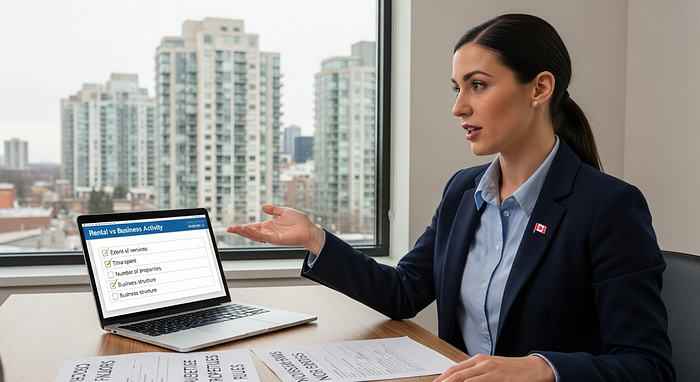
For non-residents earning income from Canadian property, the Canada Revenue Agency (CRA) doesn’t always treat rental income the same way. In many cases, it’s considered passive income under Section 216 — but sometimes, the CRA reclassifies it as a business activity.
That reclassification can dramatically change your tax obligations, filing requirements, and exposure to audits. Let’s break down how the CRA makes this decision — and what it means for you as a non-resident landlord.
1. The CRA’s Two Main Categories
In Canada, the CRA divides rental activity into two main categories:
Passive Rental Income: Regular rent from property, typically requiring minimal involvement.
Business Income: Active operations involving services or high levels of management.
Why the distinction? Because business income is taxed differently. If the CRA considers your rental activity a business, you may no longer qualify under Section 216 — and instead, you’ll be taxed under Part I of the Income Tax Act, possibly at higher rates.
2. What Factors the CRA Looks At
The CRA examines several key factors to determine if your rental income is passive or business-related:
Frequency and volume of rentals — Frequent or multiple short-term stays may indicate business activity.
Level of personal involvement — Are you managing guests, providing daily services, or hiring staff?
Additional services offered — Cleaning, meals, tours, or concierge support can shift classification.
Use of platforms — Running multiple Airbnb listings, for instance, often triggers business treatment.
Profit motive and scale — If you operate like a business for profit rather than investment, the CRA notices.
The more “hands-on” your rental operation is, the more likely the CRA will view it as a business.
3. What Happens If It’s Considered a Business
If your activity is deemed a business, several new tax rules kick in:
You can no longer use Section 216 to file.
You must file a T1 (individual) or T2 (corporate) return instead.
You may be required to register for GST/HST if your revenue exceeds $30,000 CAD in 12 months.
Your profits are taxed at standard Canadian business rates, not withholding rates.
You must keep business-level accounting records for all income and expenses.
This classification can lead to higher tax obligations — but it can also allow more deductions if handled correctly.
4. The CRA’s “Airbnb Effect”
Short-term rental platforms like Airbnb and Vrbo have made this issue more common. Many non-residents list properties frequently, handle multiple guests, and offer hotel-style amenities.
In these cases, the CRA often reclassifies the income as business activity, especially if the property is rented for short periods to many guests throughout the year.
5. How to Stay in the Right Category
To remain under Section 216 (the more favorable regime), you should:
Limit short-term stays and guest services.
Use a property manager instead of self-managing every booking.
Keep the activity as “rental” rather than “hospitality.”
Document all transactions and correspondence with tenants.
