
Are Residential and Commercial Properties Taxed Differently for Non-Residents?
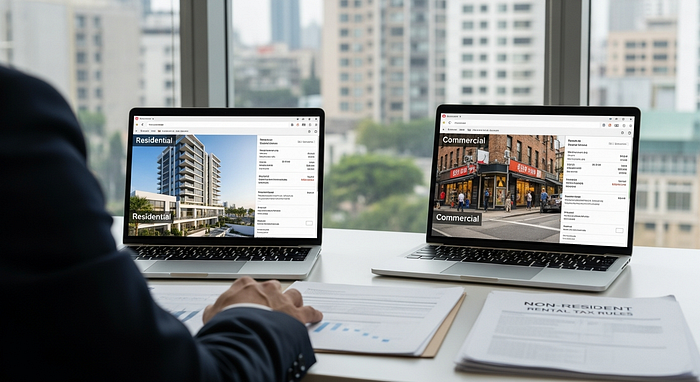
If you’re a non-resident earning rental income in Canada, you might be wondering whether the CRA taxes residential and commercial properties differently. After all, a downtown Toronto office space is a far cry from a single-family rental home — so shouldn’t the taxes differ too?
The short answer is yes and no. The basic rules for non-resident taxation apply to both, but the details and deductions can vary depending on the type of property and how it’s used.
Let’s break down how residential and commercial rental properties are treated under Canadian tax law.
The Common Ground: Canadian-Source Rental Income
No matter what kind of property you rent out — condo, apartment, warehouse, or retail unit — the CRA classifies it as Canadian-source income if it’s located in Canada. That means all non-residents must pay Canadian tax on their rental earnings.
By default, the CRA requires 25% withholding tax on gross rent. This applies equally to residential and commercial properties.
However, you can reduce that burden by filing under Section 216, which allows you to pay tax on net rental income instead of gross rent. The same forms (NR6 and Section 216 return) are used for both property types.
Residential Property: Simpler, More Predictable
Residential rentals are typically treated as passive income. You’re earning rent, not running a business. This means:
You can elect under Section 216
You can deduct property-related expenses (taxes, insurance, repairs, mortgage interest, etc.)
You’re taxed on net income using standard Canadian tax rates
For most non-residents, residential rentals are easier to manage tax-wise — especially if you use a property manager to handle payments and maintenance.
Commercial Property: More Complex and Heavily Regulated
Commercial rentals, on the other hand, can be more complicated.
If your rental activity involves business operations — for example, leasing to multiple tenants, managing large commercial spaces, or providing additional services — the CRA may classify your income as business income rather than passive rental income.
When that happens:
You may no longer be eligible for Section 216
You might have to file a corporate or business tax return under Part I
You could be subject to GST/HST obligations depending on revenue and location
Record-keeping and reporting requirements increase
In short, commercial rentals often mean more paperwork and potentially higher taxes — but also more opportunities for business deductions.
Property Use Also Matters
If you rent part of a property commercially and part residentially — like a mixed-use building — you’ll need to allocate income and expenses proportionally. The CRA expects clear separation between residential and business activity for proper reporting.
The Bottom Line
Both residential and commercial properties are taxable for non-residents, but the complexity and classification differ. Residential rentals are usually straightforward under Section 216, while commercial rentals may cross into business territory, requiring deeper planning.
